
Contents
Overview
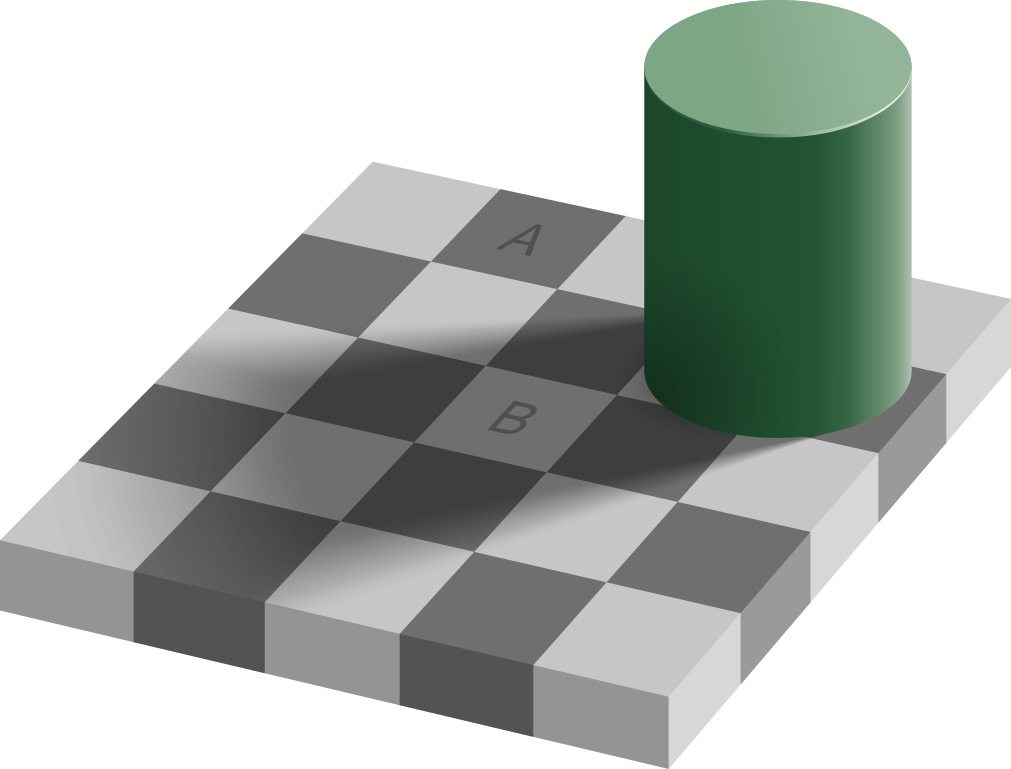
Optical illusions are visual perceptions that deviate from objective reality, tricking the eye and brain into seeing something that isn't there or is distorted. These phenomena, ranging from simple physical distortions like a bent stick in water to complex cognitive paradoxes, reveal the intricate workings of human vision and perception. They are not mere tricks but powerful tools for understanding how our visual system processes information, often by exploiting ambiguities, distortions, paradoxes, and fictions inherent in the way we see. From ancient art to modern neuroscience, optical illusions have captivated artists, scientists, and the general public, serving as a constant reminder that our perception of the world is an active construction, not a passive reception of reality. Their study bridges art and science, offering insights into everything from artistic techniques to the fundamental mechanisms of sight.
🎵 Origins & History
The fascination with optical illusions predates recorded history, with early examples found in ancient cave paintings and architectural designs that played with perspective. Pioneers like Richard Gregory explored the physiological basis of vision and perception, laying groundwork for understanding why these illusions occur. The early 20th century saw the rise of Gestalt psychologists who proposed that the brain perceives wholes rather than just sums of parts, explaining phenomena like the phi phenomenon and the tendency to see patterns. Later, figures like Richard Gregory would categorize illusions into physical, physiological, and cognitive types, providing a framework still referenced today. The development of new artistic movements, such as Surrealism and Op Art, further integrated these visual paradoxes into mainstream culture.
⚙️ How It Works
Optical illusions arise from the complex interplay between the physical properties of light, the biological mechanisms of the eye, and the cognitive processing within the brain. Physical illusions are caused by the physical properties of light. Physiological illusions result from the overstimulation or adaptation of sensory receptors in the eye, like the photoreceptor cells in the retina. Cognitive illusions, the most diverse group, occur in the brain's interpretation of visual information, often stemming from assumptions the brain makes about the world. These include ambiguous images (like the Necker cube), distorting illusions (like the Müller-Lyer illusion), paradoxical illusions (like the Penrose triangle), and fictional illusions (like seeing shapes in clouds). Each type highlights a different aspect of how our visual system constructs reality.
📊 Key Facts & Numbers
It's estimated that over 90% of the information the human brain receives is visual, making our perception highly susceptible to manipulation. Studies suggest that the Ames room illusion demonstrates how our brain interprets size based on perceived distance, making people appear to grow or shrink as they move across the room. The Ponzo illusion shows how converging lines can make two identical objects appear different in size, a principle utilized in railroad tracks and highway design. The sheer volume of visual data processed means that shortcuts and assumptions are necessary, making illusions a common byproduct of efficient perception.
👥 Key People & Organizations
Key figures in the study of optical illusions include Richard Gregory, a British psychologist who extensively researched and categorized visual illusions, proposing the 'holographic theory' of perception. Organizations like the Vision Sciences Society continue to foster research in this interdisciplinary field. Optical illusions have permeated art, design, and popular culture for centuries. The Op Art movement of the 1960s specifically aimed to create illusions of movement, vibration, and depth using precise geometric patterns. Beyond fine art, illusions influence graphic design, advertising, and even stage magic, where misdirection and visual trickery are paramount. They are also a staple in children's books and educational materials, serving as engaging ways to teach about perception and the brain. The widespread appeal of optical illusions is evident in their constant presence in online content, puzzles, and interactive exhibits worldwide.
🌍 Cultural Impact & Influence
The study and creation of optical illusions are more dynamic than ever, driven by advancements in digital technology and neuroscience. Researchers are increasingly using virtual reality (VR) and augmented reality (AR) to create immersive perceptual experiences and test theories of vision in novel ways. The field of neuroscience continues to explore the neural correlates of visual perception, using illusions as probes to understand brain function. Platforms like YouTube and Instagram have become major hubs for sharing and experiencing optical illusions, reaching global audiences instantly.
⚡ Current State & Latest Developments
One persistent debate surrounds the fundamental nature of illusions: are they errors in perception or simply the result of the brain applying normal, efficient processing rules to ambiguous or unusual stimuli? Richard Gregory's view often leans towards illusions being 'misapplied constancies,' where the brain uses rules that work in normal environments but fail in specific, artificial situations. Skeptics argue that this framing pathologizes normal perception. Another controversy lies in the categorization itself; while Gregory's physical, physiological, and cognitive framework is widely used, many illusions blur these lines, making strict classification difficult. Furthermore, the ethical implications of using illusions in advertising or design are sometimes questioned, particularly if they are used to mislead consumers. The debate also extends to whether illusions reveal fundamental truths about perception or are merely artifacts of specific experimental setups.
🤔 Controversies & Debates
The future of optical illusions is intrinsically linked to advancements in artificial intelligence (AI) and computational neuroscience. AI systems are being trained to recognize and even generate visual illusions, potentially leading to new forms of art and design, as well as more sophisticated visual recognition systems. Researchers anticipate that VR and AR technologies will offer unprecedented opportunities to create and study illusions in controlled, interactive environments, allowing for more nuanced understanding of perceptual mechanisms.
Key Facts
- Category
- aesthetics
- Type
- topic