
Contents
Overview
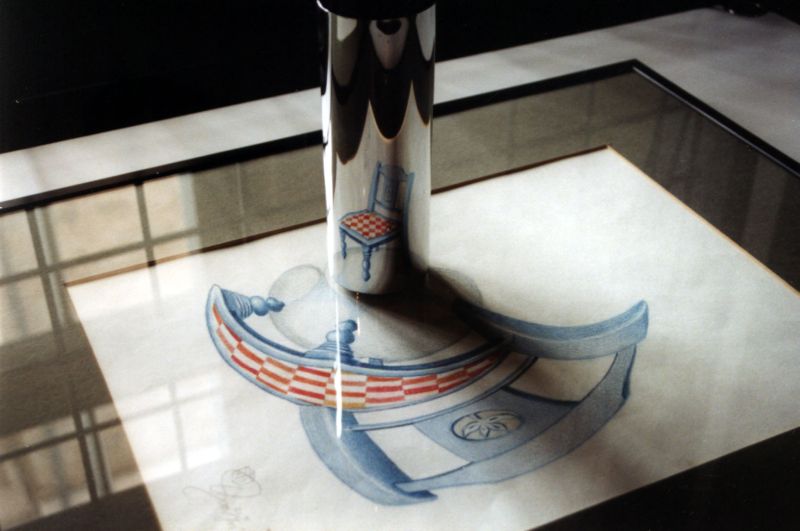
Anamorphic art employs optical distortion to create images that appear normal only from a specific viewpoint or with the aid of a reflective device. This technique, rooted in the Renaissance's fascination with perspective, transforms flat surfaces into dynamic, often surprising, visual experiences. Artists utilize anamorphic projection to embed hidden messages, create illusions of depth, or simply to challenge the viewer's perception of space and form. From ancient cave paintings to modern street art and digital installations, anamorphic art has consistently pushed the boundaries of visual representation, demanding active participation from the observer to resolve the distorted elements into a coherent whole. Its enduring appeal lies in its ability to play with our understanding of reality, making the act of seeing itself an integral part of the artwork.
🎨 Origins & History
At its core, anamorphic art manipulates the principles of geometry and optics to create a deliberate visual distortion. An image is stretched or compressed along one axis, making it appear unintelligible when viewed head-on. However, when the viewer shifts their position to a specific vantage point, or when the image is reflected in a specially shaped mirror (like a cylindrical or conical mirror), the distortion is corrected, revealing the intended, undistorted image. This requires precise calculation of the projection angles and the viewer's intended position. For instance, a street artist might paint a mural on a flat pavement, but from a single, elevated viewpoint, it appears as a three-dimensional object seemingly rising from the ground, a technique often referred to as trompe-l'oeil anamorphic street art.
📐 How It Works
Anamorphic lenses were used to create widescreen formats like CinemaScope and Panavision. In cinema, these formats allow for expansive compositions and a heightened sense of realism or spectacle, impacting the visual language of countless films.
📊 Key Facts & Numbers
Pioneers in anamorphic art include Jean-François Nicéron, whose 17th-century writings were foundational. In contemporary street art, artists like Julian Beever and Edgar Müller have gained international fame for their large-scale pavement illusions, drawing millions of viewers to public spaces. Kurt Wenner is credited with popularizing the term '3D street art' and developing techniques for creating these immersive works. In the realm of film, directors like David Lean and Alfred Hitchcock frequently utilized anamorphic formats to enhance visual storytelling. The Anamorphosis Society (a hypothetical organization representing practitioners and enthusiasts) would likely champion the preservation and study of these works.
👥 Key People & Organizations
Its ability to transform mundane surfaces into extraordinary scenes has made it a powerful tool for urban regeneration and tourism, drawing crowds to witness these ephemeral masterpieces. The technique also appears in augmented reality and virtual reality experiences, where digital distortions can be used to create immersive and interactive environments. The widespread adoption of anamorphic lenses in photography and videography for creating wide-screen effects further demonstrates its pervasive cultural reach.
🌍 Cultural Impact & Influence
The digital age has opened new frontiers for anamorphic art. Artists are now creating anamorphic illusions using 3D modeling software and VR headsets, allowing for interactive and dynamic experiences that transcend physical limitations. AR apps can overlay anamorphic distortions onto real-world environments, offering novel ways for audiences to engage with art. Furthermore, advancements in projection mapping technology allow for anamorphic illusions to be cast onto complex architectural surfaces, creating breathtaking temporary installations. The ongoing exploration of computational art and generative design promises even more sophisticated and personalized anamorphic experiences in the coming years, potentially integrating AI-driven perspective adjustments.
⚡ Current State & Latest Developments
One of the primary debates surrounding anamorphic art centers on its ephemerality, particularly in street art, where works are often temporary and subject to weather or urban development. Critics sometimes question whether the spectacle of the illusion overshadows the artistic merit or message. Another point of contention is the accessibility of the art; while street art is publicly displayed, the specific vantage point required can limit the number of people who can fully appreciate the intended effect simultaneously. In film, the debate often revolves around the aesthetic choices imposed by anamorphic formats, with some arguing that they can lead to image distortion or lens flares that detract from the director's vision, while others champion the unique visual qualities they impart.
🤔 Controversies & Debates
Anamorphic art's practical applications extend beyond fine art and cinema. In architecture and urban planning, it's used to create illusions of space, making small areas appear larger or altering the perceived scale of buildings. It's also employed in advertising and product design to create eye-catching displays and packaging. In education, anamorphic principles can be used to teach concepts of geometry, optics, and spatial reasoning. Even in everyday objects, like certain types of optical illusion toys or advertising billboards, anamorphic techniques are subtly utilized to grab attention and convey information in novel ways.
🔮 Future Outlook & Predictions
Anamorphic art is deeply connected to the broader study of optics and visual perception. Its historical development is inseparable from the evolution of perspective drawing and the Renaissance's scientific inquiry into how we see. Related artistic movements include Surrealism, which also plays with distorted realities, and Op Art, which uses optical illusions to create dynamic visual effects. The techniques employed in anamorphic art also find parallels in computer graphics.
Key Facts
- Category
- aesthetics
- Type
- topic